Critical Energy Infrastructure Hub (CEI Hub)
The Ticking Time Bomb Next to the Willamette River in NW Portland
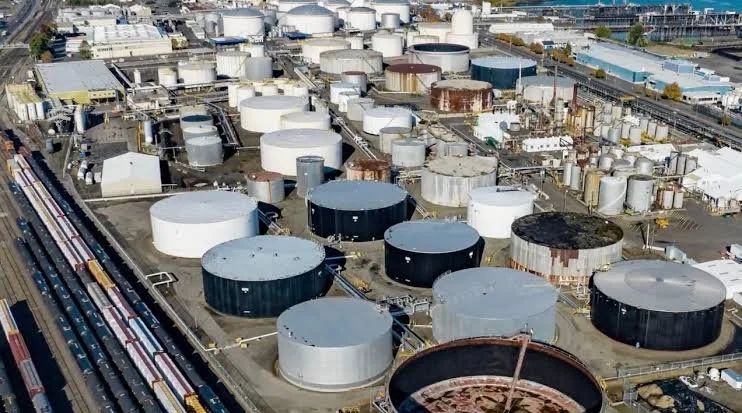
It has been called a looming “disaster on the order of Fukushima and Deepwater Horizon combined: ”350 million gallons of flammable, combustible, and toxic fuels held in 600 above-ground, mostly aging bulk storage tanks lining 6 miles of Willamette riverbank.” The tanks hold 90% of Oregon’s liquid fuel supply -- gasoline, diesel, jet fuel. It is Oregon’s “Critical Energy Infrastructure Hub” (CEI Hub), essential to our current economy, but it couldn’t be in a worse place.
Beginning in the 1920s, 11 tank farms were built along the Willamette from Northwest Portland to beyond the St. Johns Bridge, primarily on sandy fill soils dredged from the river as the city expanded. Most tanks were added around the 1950s, long before our understanding of Portland’s Cascadia earthquake risk. The result: more than 90% of CEI Hub tanks were built before the establishment of modern seismic standards in 1993 and are at high spill risk in a seismic event. When the inevitable “Big One” strikes, the soil beneath the tanks will liquefy, causing the ground to sink and shift and current riverbanks to slide back into the river.
Multiple studies have concluded that many of the aging tanks will rupture and spill in the megaquake, creating open pools of gasoline, diesel, jet fuel, and ethanol. Any spark, from an electrical line, colliding tanks, or derailed oil train cars, could then ignite the spilled fuels. An explosive fireball could potentially extend from NW Portland to beyond the St. Johns Bridge, sending toxic fumes across the city and setting Forest Park and neighboring communities and industries on fire. Almost certainly, the spill alone would contaminate the Willamette and Columbia ecosystems all the way to the mouth of the Columbia, an area of environmental and economic devastation that will take decades to recover.
No one has developed a viable plan to move the Hub to safer ground, given its necessary connections to major pipelines, marine, rail, and trucking hubs. But based on community advocacy, some risk mitigation legislation is being enacted at the State and local level:
In 2022, SB 1567 was signed into Oregon law requiring the largest-capacity oil and fuel distributors to assess the potential damage a 9.0 earthquake would have on their facilities. It required operators to provide a comprehensive Seismic Vulnerability Assessment (SVA) for their facility and then design a “Risk Mitigation Implementation Plan” (RMIP) to be completed within 10 years. Risk mitigation under this statute may be limited given that operators have the option to simply build “containment walls” around their facilities rather than rebuilding tanks to current seismic standards, limiting spill spread but leaving open pools of flammable fuels along the river. CEI Hub operators have been slow to respond with SVAs, initially due in June 2024, still incomplete.
We expect legislators committed to addressing CEI Hub risk to introduce further legislation in the upcoming 2027 session.
At the end of 2026, the Portland City Council passed updates to its 35-year land use Comprehensive Plan and its Zoning Code to address CEI Hub risk. For the first time, Portland land use policy now formally acknowledges the safety and health risk presented by the CEI Hub and calls for transition to a decarbonized economy. Further, Portland zoning code will now require any expansion of fuel infrastructure at the hub to go through a formal quasi-judicial land use review based on established criteria, including demonstration of need. Those reviews are appealable to City Council, meaning that final decisions on CEI Hub expansions are not simply “administrative” decisions, beyond the reach of public process.
Portland City Council also passed a CEI Hub “Fuel Reduction Program.” Because the risk the Hub poses depends on the amount of fuel held on site when a catastrophe occurs, lowering average fuel volumes is crucial to reducing risk. As transportation transitions to electric vehicles, the Hub will need less fuel to meet Oregon and regional needs, allowing fuel reductions that don’t create shortages. While the Fuel Reduction Program currently focuses only on reducing tank capacity (not average fuel level) by 20% in 2036, council tasked city staff with recalculating reductions using facility-provided data on average tank fuel fill levels to refocus reductions on the amount of fuel held on site for council consideration in 2027.
None of these first steps at CEI Hub risk mitigation would have occurred without long-term community advocacy. A broad coalition of advocates from environmental, climate, professional, community, social justice, faith, and youth organizations has spent years educating leaders and neighborhood members, lobbying state and local officials, and engaging over legislative proposals to increase safety and lower risk. Willamette Riverkeeper leaders have provided leadership in these efforts and are committed for the long term.
The CEI Hub is undoubtedly the single greatest point-source risk to the Willamette River, its ecosystem, and the communities that enjoy its watershed. It has to be a priority for all of us.